
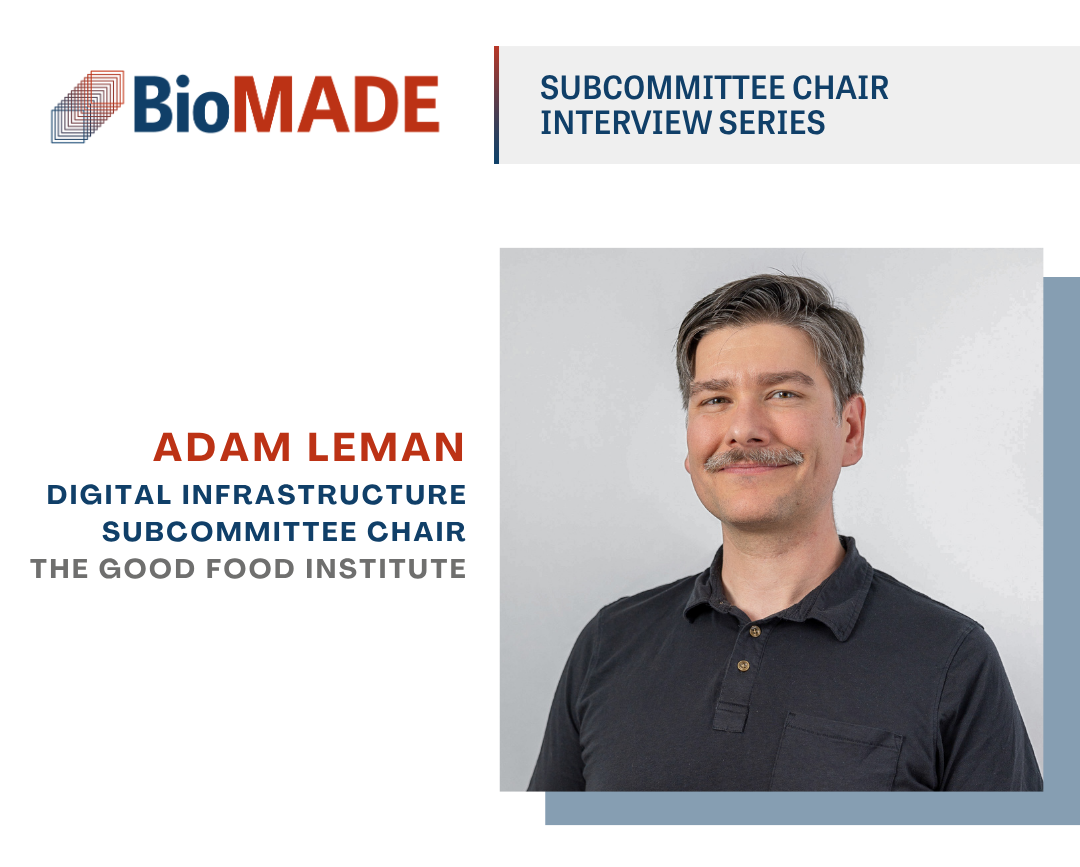
In one sentence, what is the value of participating in this subcommittee?
We seek to help BioMADE and members maximize the value of data in biomanufacturing by building recommendations and frameworks for data’s role in biomanufacturing, like acquisition, modeling, and data-driven decision-making.
What challenge or opportunity is your subcommittee currently focused on?
We are currently building process guides for modeling biomanufacturing at different scales. For example, how could a lab-scale startup use the data they have collected to build a credible model for what they could expect at pilot scale? What sort of data would be needed? What assumptions can they make? Having a guide to model construction will lay out clear goals and requirements for the industry.
What accomplishment or impact from your subcommittee are you most excited about so far?
DISC has supported the Digital Backbone team at BioMADE, and I think we blended support for their data tools with a clear landscape of the challenges in our increasingly data-rich industry. We delivered an overview of the challenges in data structures, ontologies, labeling, and metadata last year. It was quite revealing how everyone builds these environments nearly from scratch every time a company or organization gets built. At some point, we’ll determine whether data standardization offers an advantage and how to incentivize it.
What’s next for the subcommittee, and how can members get involved?
Our next big project is our analysis of biomanufacturing technical modeling. We are early in the process of defining the project goals, deliverables, and timeline. Now would be a great time to get involved and get “in on the ground floor.
What is something this subcommittee can accomplish together that would be difficult for any single organization to do alone?
I’m really happy with how our subcommittee draws on expertise from across the biomanufacturing value chain. Biologists, engineers, data scientists coming from a variety of company sizes and stages all attend the meetings and participate. I think that our big strength is in the breadth of end products: fuels, proteins, polymers, oils, and more. I think that the diversity of production processes leads us to solutions and topics that have impact across the whole sector.
What would you say to a BioMADE member who is considering joining but isn’t sure they have the right expertise?
I would say that, for DISC, interest is more important than expertise. For people looking to integrate data, analysis, modeling, or other data-related work into their biomanufacturing roles, the opportunities to learn collaboratively and clearly identify gaps and opportunities across the field require looking at the problem from both sides. I think that great things happen on cross-cutting committees; everyone can come to DISC to learn something new and to share their view and expertise on data in all aspects of biomanufacturing.