
Technology & Innovation Projects
BioMADE is moving the bioindustrial manufacturing industry forward by funding innovative research, reducing barriers to scaling-up and commercialization, and de-risking investment in relevant infrastructure. BioMADE accelerates the commercialization of modern biotechnology products and identifies domestic supplies of important materials by focusing on the pilot-scale Manufacturing Readiness Levels (MRLs) 4-7.
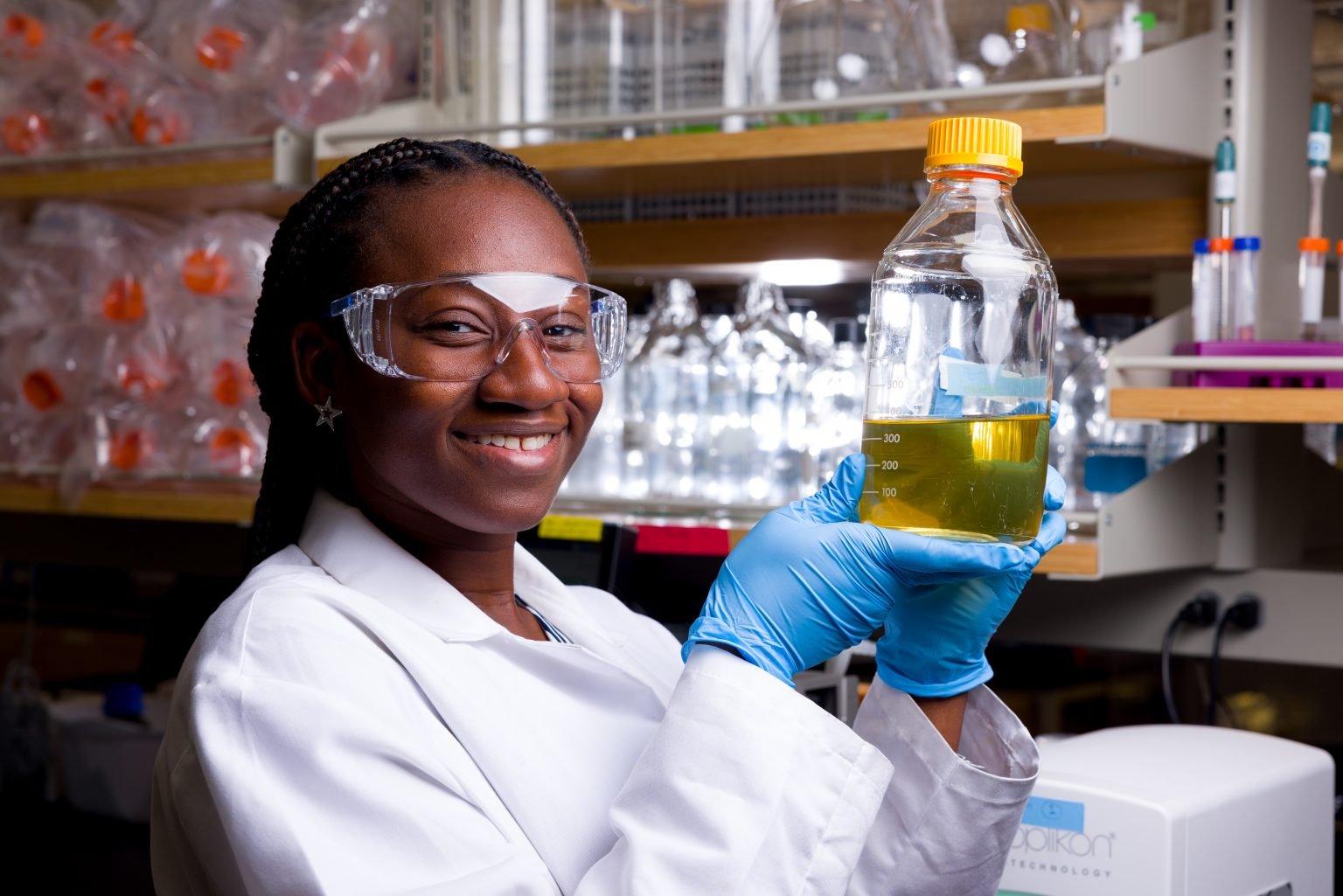
Photo above © Iowa State University

© Ginkgo Bioworks
Manipulate
Projects that are developing predictive models, new tools, and robust platforms to ease the transition from lab to production scale.
Active Projects
-
Through developing a first-of-its-kind predictive AI model for protein production, this project will accelerate strain optimization for the production of resilient and cost-effective proteins capable of wound healing, advanced nutrition, chemical defense, or other defense-relevant compounds. Learn more here.
Members: Triplebar, University of California, Berkeley
-
This project will establish and evaluate Deep Stability Scanning, a method that synergizes advances in DNA synthesis, machine learning-enabled protein design, and high-throughput screening, for protein engineering. Learn more here.
Members: University of Texas at Austin and Twist Bioscience
Completed Projects
-
This project elevated the commercial readiness of bioproducts by developing practical metrics of product development performance and identifying best practices that are leading to higher performing products. Learn more here.
Members: University of California, Berkeley, R2DIO, Antheia, Geno, Amyris, Oobli
-
Through this project, Agri-Tech Producers came one step closer to making sustainable high-performance, lightweight bio-based materials that can be used in aerospace, automotive, and sports and recreation industries. Learn more here.
Members: Agri-Tech Producers, University of Akron School of Polymer Science and Polymer Engineering
-
Through this project, members engineered oleaginous yeast strains and tested downstream processing methods to produce single-cell oil at higher yield and lower cost. Learn more here.
Members: University of Delaware, Zero Acre Farms
-
This interdisciplinary research team evaluated seven antigen expression platforms utilizing bacterial, yeast, fungal, plant and mammalian cell hosts. The team compared metrics across platforms such as volumetric productivity, cost, production timeline, and functional properties. Antigens are important for use as research reagents, serological testing such as test kits, and vaccines. Learn more here.
Members: University of California, Davis, Boston University, University of Texas-Austin, Johns Hopkins University, University of Georgia, and Rensselaer Polytechnic Institute
-
Researchers are collaborating to improve intracellular product recovery from yeast systems by engineering programmed lysis of the cell wall. Learn more here.
Members: Manus and University of Texas at Austin
-
Members teamed up to produce and characterize novel magnetic nanoparticles called magnetosomes which are suitable for a wide range of applications including advanced electronics, batteries, and satellite communications. Learn more here.
Members: Superbrewed Food, Lockheed Martin
-
Through this project, members evaluated the suitability of the H.E.L. BioXplorer 400P bioreactor system for simulating scaled-up fermentation bioprocess conditions. Learn more here.
Members: Checkerspot, University of California, Davis

© North Carolina State University
Accumulate
Projects that are producing relevant quantities of materials as quickly and efficiently as possible.
Active Projects
-
This project will adapt promising pre-treatment technologies for bioindustrial manufacturing with feedstocks from Hawaii, conduct training for remote rural environments, and include culturally appropriate approaches to ensure community acceptance. Learn more here.
Members: National Corn-to-Ethanol Research Center and University of Hawai‘i – Hilo
-
This project will develop a smart sensing system to monitor industrial fermentation tanks in real time, using a network of sensors that float freely inside the tanks to provide high-quality data with precise time and location information. Learn more here.
Members: Boston University, Capra Biosciences
-
This project will develop and validate a scalable microbial process for extracting lithium from produced water for use in products like batteries, aircraft, lubricants, glass, and more. Learn more here.
Member: AlkaLi Labs
-
This project will accelerate the commercialization of the anaerobic bio-production of 3-hydroxypropionic acid (3-HP) – an important molecule that’s a precursor to the $25 billion acrylates industry – by leveraging existing ethanol infrastructure. Acrylates have diverse applications, including consumer products paints, and adhesives. Learn more here.
Members: Bluestem Biosciences, ideaCHEM, Iowa State University, Southeast Community College
-
By harnessing cutting-edge technology, this project will convert diverse organic waste streams into high-value medium-chain carboxylic acids (MCCAs) such as caproic and caprylic acid. These bioproducts serve as pivotal platform chemicals for a multitude of applications, including as materials, consumer products, chemicals, and fuels. Learn more here.
Members: Johns Hopkins Whiting School of Engineering, Technology Holding, CleanJoule
Completed Projects
-
This research focused on production of bio-based alternatives to petroleum-derived acrylic acid using a minimally engineered microbial strain. Learn more here.
Member: MicroByre
-
Researchers created and commercialized a new biopolymer precursor through sugar fermentation. The trademarked product, Nuvone, can be used in flexible polymers such as plastics, foams, and adhesives; as well as in textiles such as leggings and shoes. Learn more here.
Members: Valerian Materials, National Corn-to-Ethanol Research Center, University of Minnesota
-
This project developed a flexible bioreactor design that combines fermentation, product extraction, and separation into a single device, enabling biomanufacturers to carry out efficient small-volume production without relying on large, specialized facilities. Learn more here.
Member: Iowa State University
-
This project scaled up production of microalgal oils for use in a wide range of industries and products, from materials to foods. Learn more here.
Member: Checkerspot
-
This project evaluated using Mango Materials’ PHA bioplastic produced using waste gases from from wastewater treatment plants as a bio-based alternative to petroleum-based plastics for applications like 3D printing, films, and fibers. Learn more here.
Members: Mango Materials, University of California, Davis, Black & Veatch
-
This project advanced a modular bioreactor system that creates vitamin A through locally sourced, waste-based feedstocks. Learn more here.
Members: Capra Biosciences, Boston University, Next Rung Technology
-
Researchers developed a new, cost-effective way to make succinic acid through via fermentation. Succinic acid is an important commodity chemical used in everything from polymers, agricultural products, food and beverages, skincare, and more. Learn more here.
Member: University of Illinois at Urbana-Champaign
-
Researchers at Iowa State University designed a bioreactor that can be controlled and optimized via a reinforcement learning (RL) agent, allowing for more rapid market entry and better product quality.
Members: Iowa State University, Novonesis

© Amyris
De-Risk
Projects that are exploring new technologies, particularly around scale-up and downstream processing, and partnering with stakeholders to clarify market potential.
Active Projects
-
This project will lower the production costs of high-quality chocolate products by using cacao plant cell culture in novel bioreactors. Learn more here.
Members: University of California, Davis, California Cultured
-
This project will advance biomanufacturing of lubricants from food waste streams, providing a more secure and locally available domestic supply chain of DoD-relevant materials. Learn more here.
Members: Capra Biosciences and Virginia Tech
-
Mango Materials and UC Davis are reducing drivers of biomanufacturing costs by engineering methane-utilizing strains for use in bioplastics with applications including injection molding, films, fibers, and 3D printing. Learn more here.
Members: Mango Materials, University of California, Davis
-
This project will develop scalable, low-cost manufacturing methods for next-generation media additives that replace expensive and unstable growth factors in biomanufacturing. Learn more here.
Members: Roke Biotechnologies, Duke University
-
This project focuses on developing and validating workflows to predict the performance of oil-producing fermentations at demo-scale based on laboratory experiments. Learn more here.
Member: Geno
-
This project will evaluate a modification to both the design and operation of an aseptic production fermentor in order to minimize or eliminate the inhibitory impact of certain recombinant products. Learn more here.
Members: Amyris, Sudhin Biopharma
-
Researchers are developing a novel cell-free approach for isobutanol production. This technology creates complex yet robust cell-free enzyme systems that sustainably and affordably produce diverse chemicals. Learn more here.
Members: eXoZymes and University of Georgia
Completed Projects
-
Geno developed a proof-of-concept biomass reutilization fermentation process, increasing speed and efficiency. Learn more here.
Member: Geno
-
This project tested a novel approach for in-situ product removal (ISPR) of growth-inhibitory products in a 20-liter bioreactor using an oil-based solvent perfusion method. Learn more here.
Members: Amyris
-
This project helped create a domestic supply chain for key vaccine components that are currently sourced internationally from endangered or threatened sources. This project focused on two adjuvants – squalene and QS saponins – which are critical ingredients for vaccine effectiveness that enhance immune response.
Members: Amyris and University of California, Berkeley
-
Researchers at North Carolina State University developed a pioneering new model to predict fermentation outcomes, like biomass and product yield, across different production scales. This makes biomanufacturing more efficient and cost-effective by reducing the need for costly trial-and-error during scale-up. Learn more here.
Member: North Carolina State University
-
Lygos developed a cost-effective solution to produce Ecoteria, a bio-based malonate product platform that doesn’t rely on foreign petrochemicals or hazardous chemicals. Ecoteria is a useful building block and ingredient in a variety of applications, including agricultural chemicals, coatings, materials, pharmaceuticals, and personal care. Learn more here.
Member: Lygos
-
Through this project, member Superbrewed Food evaluated its postbiotic protein as a high-performance nutrition solution for military personnel and other demanding operational environments. Learn more here.
Member: Superbrewed Food
-
Tandem Repeat created Squitex, a fermentation-enabled protein that uses a gene originally found in the tentacles of the squid. Fermented using sugar and glycerol, this fiber has the potential to be self-healing. Learn more here.
Member: Tandem Repeat
-
Using their patented microbe, Industrial Microbes scaled up production of a bioplastic polymer (P3HP) made from ethanol from American-grown corn. P3HP is a novel material as well as a low-cost feedstock for acrylic acid and acrylonitrile. Learn more here.
Member: Industrial Microbes

Execute
Projects that are focusing on manufacturing at pilot and intermediate scale to readily transition to production partners.
Active Projects
-
This project is investigating the use of spent yeast as a feedstock for textile fibers. The textile fibers from spent yeast also offer the potential to reduce burns caused by fire or explosion, compared to synthetic fibers. Learn more here.
Members: Tandem Repeat, ARCTOS Technologies, University of Georgia
-
This project will demonstrate the viability and scalability of member Kultevat’s procedures and processes for producing natural rubber and plant-based resins from the dandelion Taraxacum kok-sakgyz (TKS). Learn more here.
Members: Kultevat, FutureFuel Chemical Company
Completed Projects
-
Origin Materials successfully tested various agricultural residues, such as woody biomass, soybean molasses, and bagasse to convert into bio-based, low-carcinogen carbon black. Learn more here.
Member: Origin Materials

© WNDR Alpine | Checkerspot
Commercial Readiness
Projects that are integrating simulation systems, technoeconomic analysis, and life cycle assessment of developing biotechnologies.
Active Projects
-
This project will develop a cost-competitive, domestic manufacturing process for carbon fiber using waste products such as ethanol and carbon dioxide. Carbon fiber has many applications, including defense, aerospace, and commercial. Learn more here.
Members: Industrial Microbes, Georgia Institute of Technology, FERMWORX
-
This project will create a digital twin fermentation model and decision-making tool that will help bioindustrial manufacturing companies better predict their scale-up operations, resulting in fewer failed runs and saving money while they produce needed chemicals and materials. Learn more here.
Members: University of Wisconsin-Madison, Geno
-
This project is developing methods to scale-up the conversion and recovery of fatty acids precursors for aviation fuel. Learn more here.
Members: Iowa State University, Kansas State University, Quasar Energy Group
Completed Projects
-
This project built JIMSONIC, the Joint Integrated Modeling for Systematic Optimization of eNvironmental Impacts and Costs. This toolkit, available to BioMADE members, can be used for predictive modeling or technologies at any stage of development. Learn more here.
Member: Amyris
-
Through this project, member General Probiotics developed a live therapeutic that can be added to chicken feed to support the production of healthy, sustainable, and affordable animal protein. Learn more here.
Member: General Probiotics
-
Researchers used computational fluid dynamics (CFD) model to formulate a validated model for gas-liquid flows in bubble columns. The team successfully simulated bubble column fermenters both at the pilot- and production-scale, demonstrating the use of CFD to predict the scale-up of fermenters. Learn more here.
Members: Iowa State University, Cargill, Geno
-
Through the development and implementation of a sophisticated digital simulation platform, this project enhanced the resilience of bioindustrial supply chains and addressed critical gaps in supply chain design and operations. Learn more here.
Member: Georgia Institute of Technology